
Michael Burry’s SOXX Puts: What the Trade Terms Tell You
Burry shared the strike and an indicative premium for his semiconductor ETF puts. Those terms are enough to work through an example payoff.
In a May 4, 2026 trading post, Michael Burry described adding January 2027 SOXX puts with a $330 strike and quoted a price in the $14s. SOXX is a semiconductor ETF. His post gives a dated account of the contract and indicative price. Its public excerpt leaves the size and current status of the position unknown. Michael Burry’s original May 4 post.
Why the underlying matters
A put on a semiconductor ETF is exposure to the fund's share price. A single company can have a strong earnings report while the ETF falls, or the other way around. When you read a position in the ETF, start with the ETF's price, holdings, and expiration window.
Work through the expiration payoff
Suppose the premium was exactly $14.50 per share. On a standard 100-share contract, that is $1,450. At expiration a $330-strike put would break even at $315.50, before costs. If SOXX settled at $300, the put's intrinsic value would be $30 per share, and the gain in this example would be $1,550 per contract. At or above $330 it would expire without intrinsic value, for a $1,450 premium loss. Before expiration, volatility and time remaining also affect the price.
Three possible uses of the same put
- Directional exposure. A trader with little existing exposure might want gains from a fall in the ETF.
- Portfolio hedge. A trader with long semiconductor holdings might use the put to offset some downside.
- Part of a spread. Another strike or expiration can change the payoff of the combined position.
These are possible uses of a put. The public terms of one option leg leave the rest of the portfolio unknown.
How this differs from a 13F
Burry's post is a dated personal account. A Form 13F is a statutory quarter-end snapshot and can report eligible held options in underlying share terms. Its reported value field is not the price paid for the options. See the Form 13F guide and SEC filing guidance.
Use the same checks on a public print
Record the underlying, expiration, strike, and observed premium. Work out the dollar cost, expiration breakeven, and payoff at a price you choose. If you came from an options flow print, check the fill side and any related legs separately.
Keep the observation date
Two traders who open the same strike and expiration on different dates can pay very different premiums. Keep the price and date from the source attached to your calculation and reprice the contract if you want to see how the payoff has changed.
Related research
Q1 2026 13F Filings: NVIDIA, Altimeter and AI Infrastructure
Read AI infrastructure holdings in NVIDIA and Altimeter’s Q1 2026 13F filings, with links to the original SEC tables and a method for comparing quarter-end share counts.
Mira Chen · Jun 8, 2026 · 5 min readWhat Is a 13F Filing? How to Read Institutional Holdings
Learn who files Form 13F, when filings are due, and how to separate a change in reported shares from a change in market value.
Mira Chen · Apr 9, 2026 · 5 min read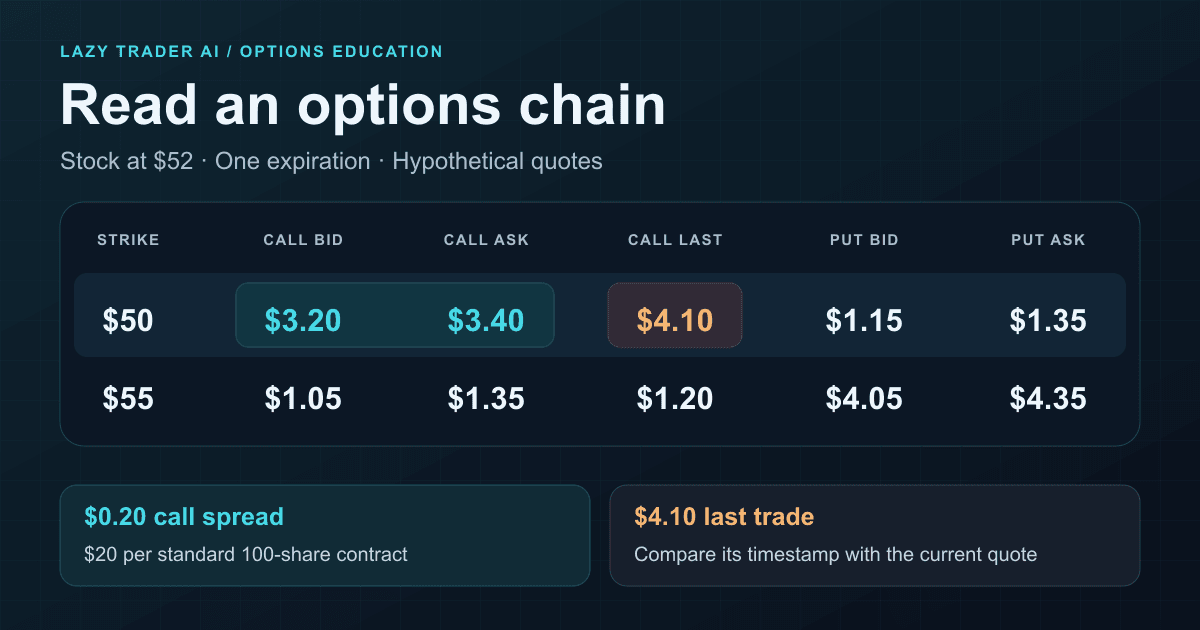
How to Read an Options Chain: A Worked Example for Beginners
Follow a sample call and put through the chain. Learn which price is current, what a quoted spread costs per contract, and how to match a flow alert to the right option.
Lazy Trader AI Research · Nov 22, 2026 · 6 min read