
How to Build a Stock Watchlist You Can Keep Up With
Give every active ticker a reason to be there, a date to revisit it, and an observation that would change your mind.
A watchlist is most useful when opening a ticker reminds you what you meant to check. Give each active name a reason to be there and a date to review it.
Start small enough to remember why each name is there. Ten to 20 active names can be a workable starting point if you review the list regularly. Adjust the size to the time you can spend.
Keep ideas with upcoming decisions on the active list. Use a research list for names you want to revisit later.
The two-list split
The structure that consistently survives the most use looks like this:
- Active list. Tickers with a research question or upcoming event you expect to check soon.
- Research list. Other companies worth reviewing periodically, such as sector peers or companies that report next month.
The split separates names you need to review now from ideas you may want to revisit later. You can keep those tiers in separate lists or mark the research candidates in your notes.
Building the active list
The active list earns its slot. Each name needs:
- A current thesis you can write in one sentence. If you can't articulate why you're watching it, it doesn't belong here.
- A clear catalyst window. Earnings, FDA, M&A rumor, technical breakout, sector rotation. Without a catalyst, it's a long-term hold, not an active watch.
- Tradeable liquidity. Avoid names with wide spreads or thin options chains. They look interesting; they execute terribly.
- An exit condition. What invalidates the thesis. Without one, the name will live on the active list forever.
Active list rule: every ticker has a thesis sentence, a catalyst, and an exit. Three sentences max. If a name fails any of the three after 30 days, it gets demoted.
Example entry: For a fictional chipmaker, watch the next earnings report for evidence that inventory is falling. Record the reporting date and review the idea after release. If inventory grows again and guidance weakens, remove it from the active list.
Building the universe list
The universe list is built differently. It's a research bench. Common starting points:
- Sector leaders. Top 5–10 names by market cap or volume in each sector you care about.
- Familiar names. Companies you can evaluate quickly when new information arrives.
- Catalyst calendars. Upcoming earnings, FDA decisions, conference dates.
- Smart-money overlap. Names appearing in recent Form 13F filings, congressional disclosures, or insider purchases. Record the period or transaction date.
- Themes. AI infrastructure, GLP-1, defense primes, Bitcoin proxies — whatever rotation you want exposure to.
Review the research list periodically for new catalysts. A name moves to the active list when you can write down what you want to learn and when you will check.
Pairing alerts to the list
The active list and the universe list have different alert needs:
- Active list alerts: specific to the reason you follow the ticker. A scheduled report reminder or a price crossing you intend to investigate can be enough.
- Universe list alerts: reserve alerts for events that would prompt a review, such as a confirmed reporting date or a material change in guidance.
Pruning ruthlessly
The single most-skipped step. Without it, every list becomes a graveyard of stale ideas:
- Monthly pass. Look at every ticker. If you can't write the one-sentence thesis from memory, it goes.
- Catalyst expiry. The earnings catalyst you were waiting for happened three weeks ago. The name doesn't belong on the active list anymore — it goes back to the universe or off the list entirely.
- Performance review. Tickers that triggered three alerts you ignored are tickers you don't actually care about. Cut them.
- Theme rotation. Sectors fall out of relevance. The 2023 AI watchlist isn't the same as the 2026 one. Refresh themes quarterly.
The hardest part is dropping names you're emotionally attached to. Every retail watchlist has them. Cut them anyway.
Use the Lazy Trader watchlist to save the symbols you want to revisit. Start with a few names and review your notes after the next catalyst.
This article is for educational purposes and is not financial advice. Lazy Trader AI is a market-monitoring tool, not a brokerage.
Related research
How to Read Options Flow Before Earnings
Compare expirations around earnings, estimate the move from an at-the-money straddle, and read options flow without assuming a price direction.
Mira Chen · Mar 27, 2026 · 5 min read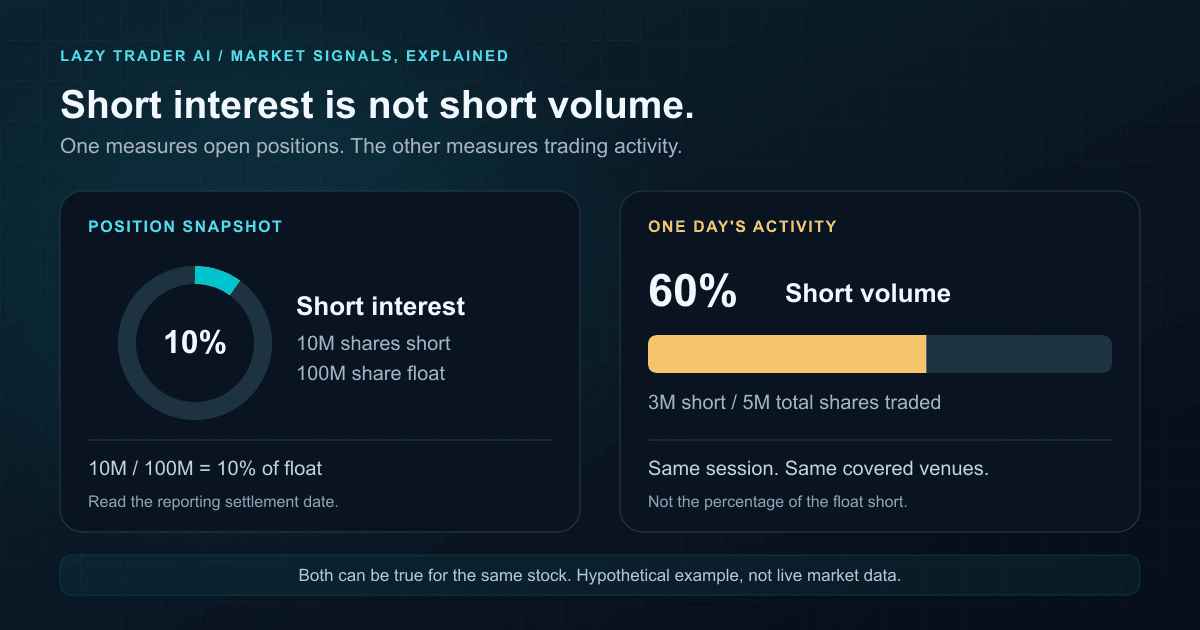
Short Interest vs. Short Volume: Why 60% Doesn't Mean a Short Squeeze
A stock can have 60% short-sale volume and only 10% short interest. Here's the math, the reporting gap, and what to check before calling a squeeze.
Lazy Trader AI Research · Oct 21, 2026 · 7 min readWhat Is a 13F Filing? How to Read Institutional Holdings
Learn who files Form 13F, when filings are due, and how to separate a change in reported shares from a change in market value.
Mira Chen · Apr 9, 2026 · 5 min read