
Options Sweeps vs. Block Trades: How to Read Each Print
A sweep describes how an order accesses liquidity. A block describes the size of a reported trade under the feed’s rules. Both labels leave questions about the trader’s wider position.
A headline like “$200,000 in call premium” tells you the dollars attached to a reported trade. The routing, fills and quote at execution can tell you more about how it traded. Trader identity, opening intent and any offsetting positions may still be unknown.
What is an options sweep?
A sweep generally routes orders to access liquidity across venues quickly. A flow provider may combine executions it believes came from the same order. Check how your feed groups fills before adding up their size or premium. Formal intermarket sweep order handling follows exchange rules. Cboe Options rule filing on sweep routing.
What is an options block trade?
A block label highlights a large execution under the feed's size and classification rules. Some large trades are arranged in advance or paired with another leg. The size alone cannot tell you the counterparty, who initiated the trade or whether this print represents the whole order.
Same strike and premium, different execution
Assume two independent, hypothetical examples for the same $50 call, each for 1,000 contracts at an average of $2.00. With a 100-share multiplier, each represents $200,000 in premium before fees.
| Example | Reported execution | Reasonable interpretation |
|---|---|---|
| Sweep | Three venues, with fills near their quoted offers | Consistent with buyer-initiated execution, if the quotes and grouping are accurate. |
| Block | One large print at the quoted midpoint | Records a large transfer. The midpoint leaves the initiating side unclear. |
Does a sweep carry a stronger directional signal?
Look at quote location and the wider trade. An ask-side call could be part of an opening purchase, a buy to close, a spread or a hedge. A block at the midpoint leaves even the execution-side interpretation less clear. Verify the quoted bid and ask from around the fill, which can differ from the price you see later. Options Industry Council guide to bid and ask prices.
Contract counts and premium also answer different questions. A trade with a high volume-to-open-interest ratio can be worth investigating while the number of contracts opened remains unknown.
What to check before interpreting a print
- Confirm the underlying, expiration, strike, and call or put. Use an options chain to identify the series.
- Read the reported side against a contemporaneous quote, and record any mid-market or unclear fills separately.
- Check whether the alert groups several fills or flags a multi-leg order. Treat possible hedges as hypotheses unless the data identifies the pairing.
- Compare the expiry with earnings or other events. Separate the reason to investigate from the case for a price move.
Try this checklist with the public options-flow preview. The public tape shows selected contract observations. Detailed execution fields depend on access and coverage.
Related research
How to Read Unusual Options Flow
Learn how to inspect option premium, fill side, volume versus open interest, and related legs before interpreting an unusual options trade.
Mira Chen · Apr 22, 2026 · 6 min read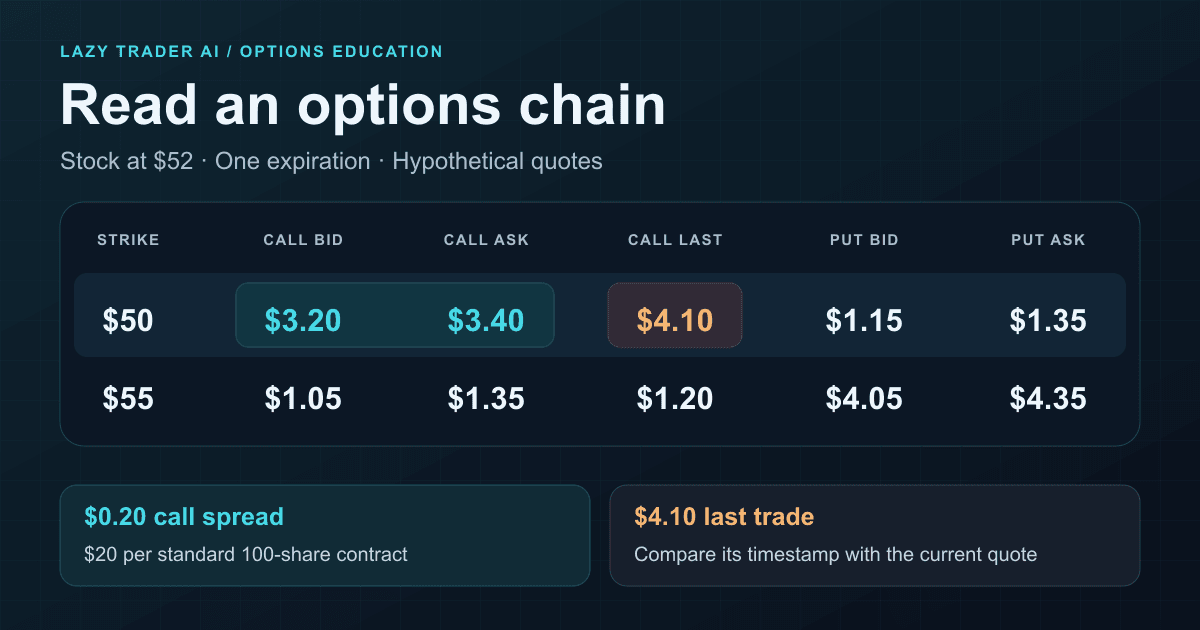
How to Read an Options Chain: A Worked Example for Beginners
Follow a sample call and put through the chain. Learn which price is current, what a quoted spread costs per contract, and how to match a flow alert to the right option.
Lazy Trader AI Research · Nov 22, 2026 · 6 min read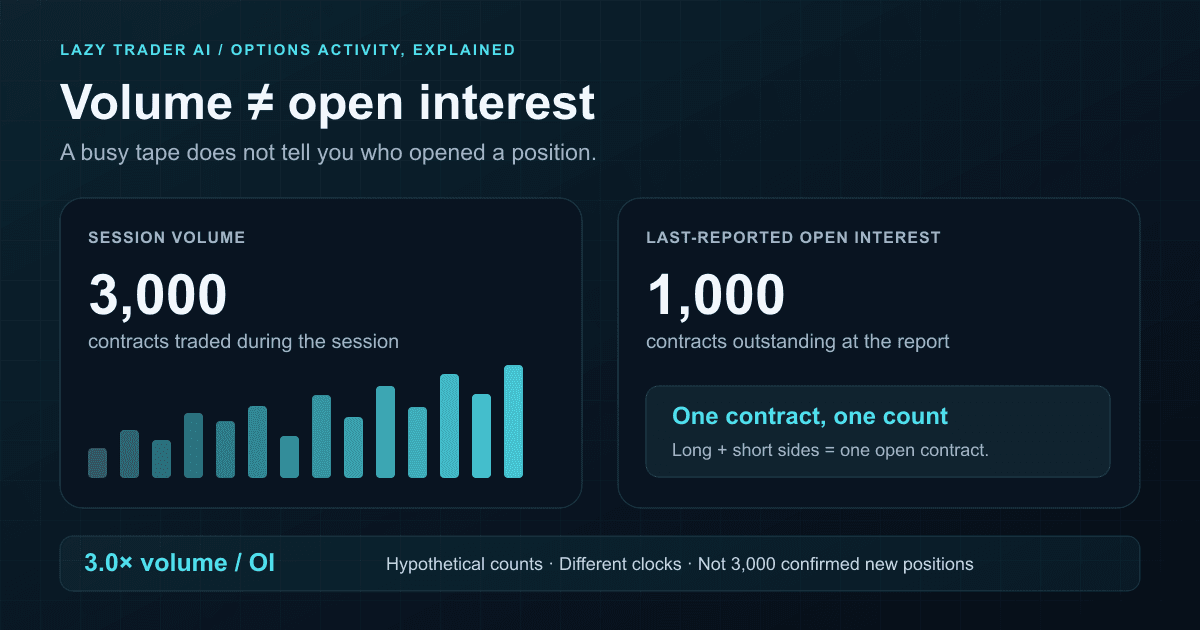
Options Volume vs. Open Interest: What a High Ratio Really Means
A contract trades three times its open interest. Is that fresh bullish buying? Learn what the numbers establish, what they leave out, and how to research the next step.
Lazy Trader AI Research · Nov 15, 2026 · 7 min read