
Options Volume vs. Open Interest: What a High Ratio Really Means
Volume counts trading activity. Open interest counts outstanding contracts. Read them together without turning a busy options tape into a claim the data cannot support.
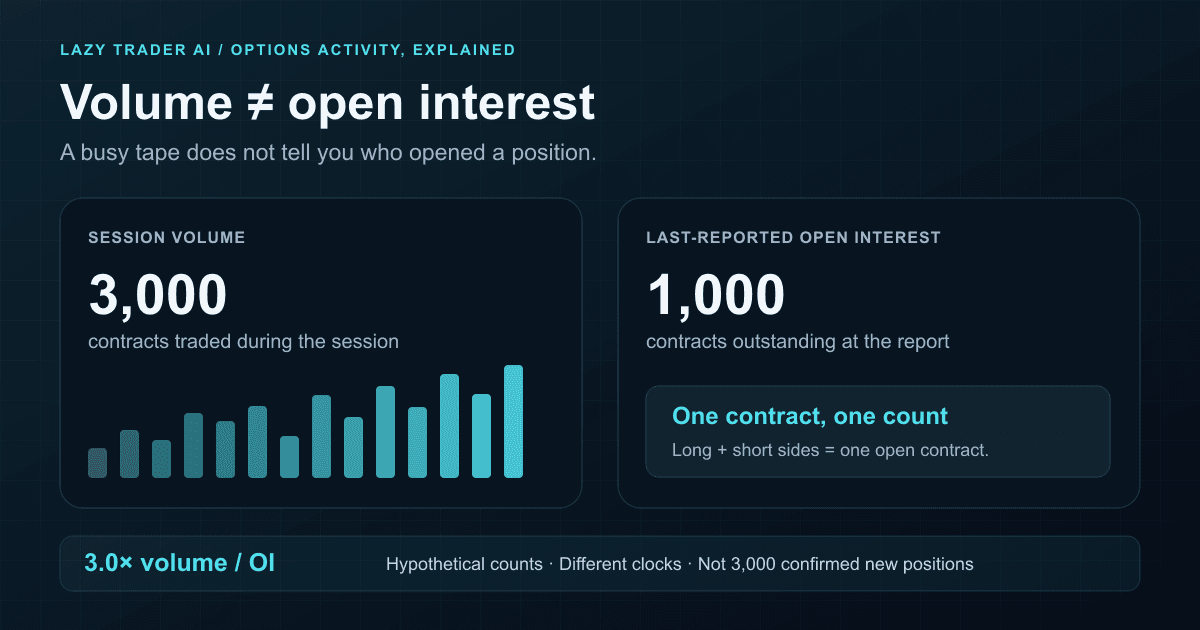
Options volume counts contracts traded during a session. Open interest counts contracts still outstanding at the reporting point. A high volume/open-interest ratio can identify activity worth investigating. It does not, by itself, identify new positions or establish a bullish or bearish view.
Imagine opening an options-flow alert and seeing 3,000 contracts traded against only 1,000 open interest. The tempting interpretation is that someone just opened a huge new bet. The useful next question is narrower: what exactly was counted, for which contract, and at what time?
Match the underlying, call or put, strike, expiry and contract terms. A stock's total options volume and the open interest of one strike are different scopes. Schwab's option-chain guide explains how a chain organizes expirations and strikes.
| Measure | What it counts | What to verify |
|---|---|---|
| Session volume | Contracts traded in the stated session | Contract, session, timestamp and feed delay |
| Open interest | Contracts still outstanding at the reporting point | Contract and OI reporting date |
| Volume/OI | Trading activity divided by reported outstanding contracts | Matching scope, a valid denominator and different update times |
What does volume higher than open interest mean?
Take a fictional $50-strike call with one particular expiry. Its last reported OI is 1,000 contracts. During the current session, 3,000 contracts trade. The ratio is:
3,000 session volume ÷ 1,000 reported OI = 3.0×
That is a comparison of activity with the reported outstanding base. It is not a count of new buyers, fresh positions or institutional investors.
Trading can include new positions, exits and transfers. Contracts can change hands repeatedly. You therefore cannot calculate the next OI as 1,000 plus 3,000 without knowing the position actions behind the trades.
If OI is zero, the ratio is undefined. If OI is missing, it is unavailable. Neither case should become an infinite-strength signal. Keep the actual contract volume visible and investigate the missing denominator.
How opening and closing trades change open interest
The two sides matter together. In the Options Industry Council's open-interest FAQ, two opening sides increase OI, two closing sides reduce it, and an opening side matched with a closing side leaves it unchanged. Buying can open a long or close a short; selling can open a short or close a long.
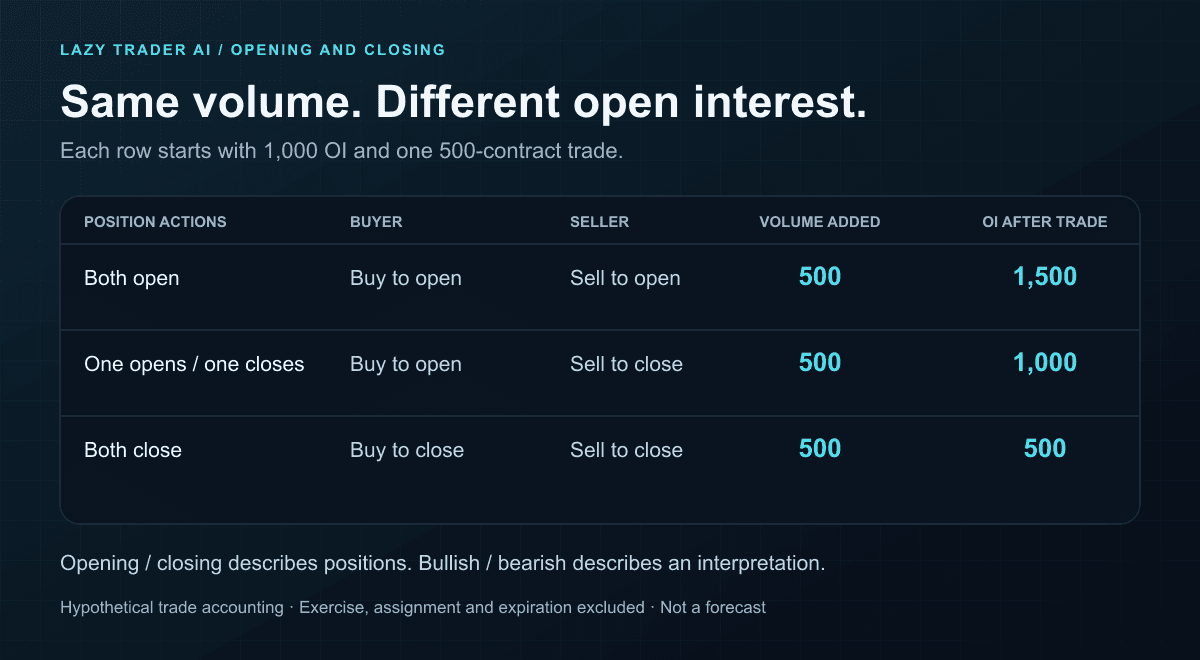
Try it: the same volume, four different position actions
Select what the buyer and seller are doing. The 500-contract trade size stays fixed. Watch which combinations change the number of outstanding contracts.
Start each independent example with 1,000 open contracts. One 500-contract trade occurs in the same option series.
- Buyer
- Buy to open
- Seller
- Sell to open
Both counterparties establish positions. Outstanding contracts increase by 500, not 1,000.
Hypothetical accounting examples, not live OI updates or trading signals. Each selection starts over; examples are not cumulative. Exercise, assignment, expiration and other adjustments are excluded.
The example assumes you know both counterparties' actions. A public print or screenshot may not provide them. A label such as “call bought at the ask” answers a different question from “both sides opened a position.”
Can the next open-interest report confirm the trade?
Check the next published OI for the same series. OCC's clearing process incorporates opening and closing activity; exercise and assignment also remove contracts. OIC's open-interest explanation describes those adjustments. OI shown beside intraday volume can therefore describe an earlier reporting point; read the dates.
Suppose the next OI for our fictional call is 1,400. Outstanding contracts rose by 400 from the original 1,000. That is not the same observation as 3,000 contracts traded during the session.
Nor can you label the remaining 2,600 contracts as closing trades. Some activity could have transferred positions without changing OI, and opening and closing transactions can offset. Aggregate OI also cannot tie a particular increase to one named trader or one print.
The careful research note is: “The contract traded 3.0× its prior reported OI; the next report showed a net increase of 400 outstanding contracts.” That statement keeps the observations separate instead of inventing the missing order history.
High volume is not the same as a good execution price
Activity metrics do not replace the executable quote. Schwab notes that volume and OI can help assess an option's liquidity, but inspect its bid, ask and quoted size too. A busy contract can still have an unattractive spread when you try to trade it.
For an original example, a $2.00 bid and $2.40 ask have a $0.40 spread. Their $2.20 midpoint is an arithmetic reference, not a promised fill. Under an assumed 100-share multiplier, that spread represents $40 per contract before costs. Check contract adjustments rather than assuming every option uses 100 shares.
Premium matters independently of volume. OIC's pricing guide separates intrinsic and extrinsic value. An active option can still carry substantial event premium. Our IV-crush example shows why the stock can move favorably while a call loses value.
A better checklist for an unusual options-flow alert
- Identify the series. Match call/put, strike, expiry and contract terms before comparing the numbers.
- Separate the clocks. Record the print time, the volume session and the OI reporting date. A newly refreshed screen does not make every field current.
- Keep the counts distinct. Contracts, print counts and premium dollars are different units. Do not add duplicate copies of the same alert.
- Read execution context. Bid/ask location can inform an execution-pressure interpretation. It does not reveal every position action, hedge or spread leg.
- Look for a reason to investigate. Compare the expiry with an earnings date or other catalyst, then check price action, available IV and expected-move context.
- Write what would change the view. A later OI report, contradictory flow or a different event timeline may weaken the original interpretation. Preserve gaps as gaps.
This is a research sequence, not a rule that a certain ratio predicts a rally. There is no universal volume/OI cutoff that proves a trade is attractive.
Put the contract back into its market context
In Lazy Trader AI, start with the public options-flow preview, then research a ticker in the app. Compare available flow records with its earnings and volatility context. Check each module's source dates and coverage instead of treating missing fields as zero.
“Which contract traded, what does its execution suggest, what is still unknown about opening intent, and what event does this expiry cover?”
Create your research workspace to explore the platform. Free previews are available; some advanced data requires Premium and coverage varies by ticker.
Common questions about options volume and open interest
Is high call open interest bullish?
Not by itself. OIC's FAQ explicitly separates OI from directional outlook. A call contract has both a long side and a short side; the count does not tell you the participants' full exposure.
Why can volume exceed open interest?
Session trading and reported outstanding contracts measure different things. Repeated trading and mixed position actions can produce high volume without an equally large increase in OI.
Does low OI automatically mean an option is untradeable?
No. Check the current spread, quoted size and actual ability to execute. Treat OI as one input, not a complete liquidity score.
Is options open interest the same as stock short interest?
No. This guide counts outstanding option contracts for a series. Stock short interest counts shares sold short that remain open. See our short-interest versus short-volume guide for that separate distinction.
Sources and methodology
Reviewed November 15, 2026. All contract counts, prices and ratios in the examples are original hypothetical inputs. They are not live ticker observations, backtests or forecasts. The interactive example isolates trade accounting and excludes exercise, assignment, expiration and other adjustments.
- Options Industry Council: General Information and Open-Interest FAQ.
- Options Industry Council: Open Interest—Why It Matters.
- Charles Schwab: The Option Chain.
- Options Industry Council: Options Pricing.
For education and research only, not financial or investment advice. Options involve substantial risk and are not suitable for every investor. See our risk disclosure.
Related research
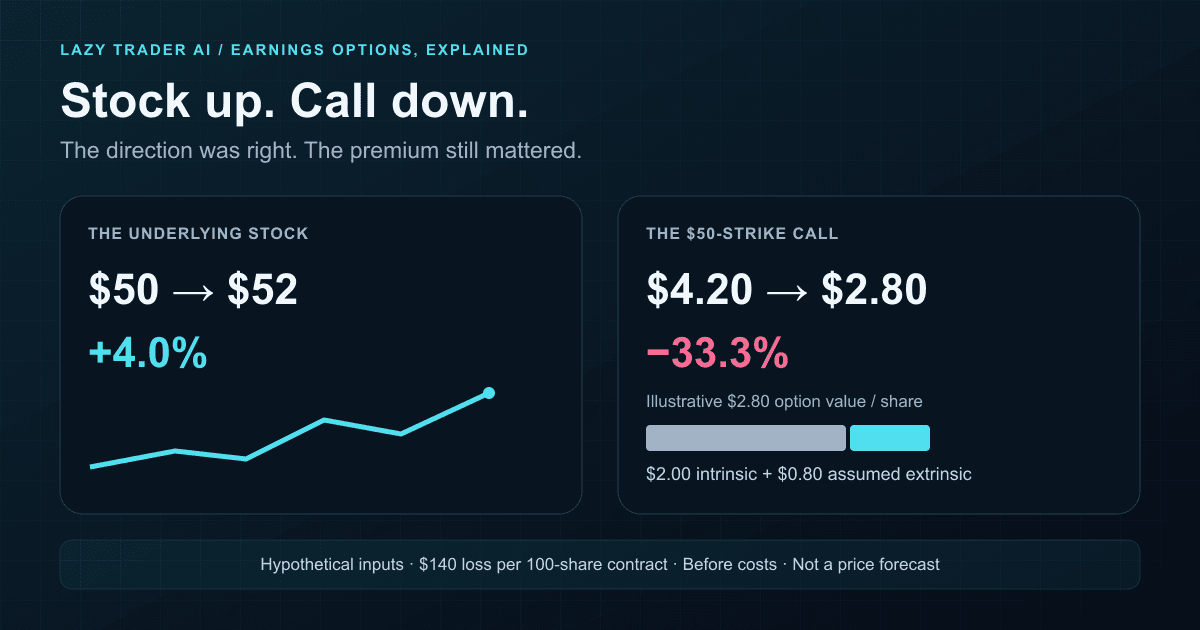
IV Crush Explained: Why Your Call Can Lose After Earnings
The stock went up. Your call went down. Understand IV crush with a worked earnings example, an interactive scenario and a contract-level research checklist.
Lazy Trader AI Research · Nov 9, 2026 · 8 min read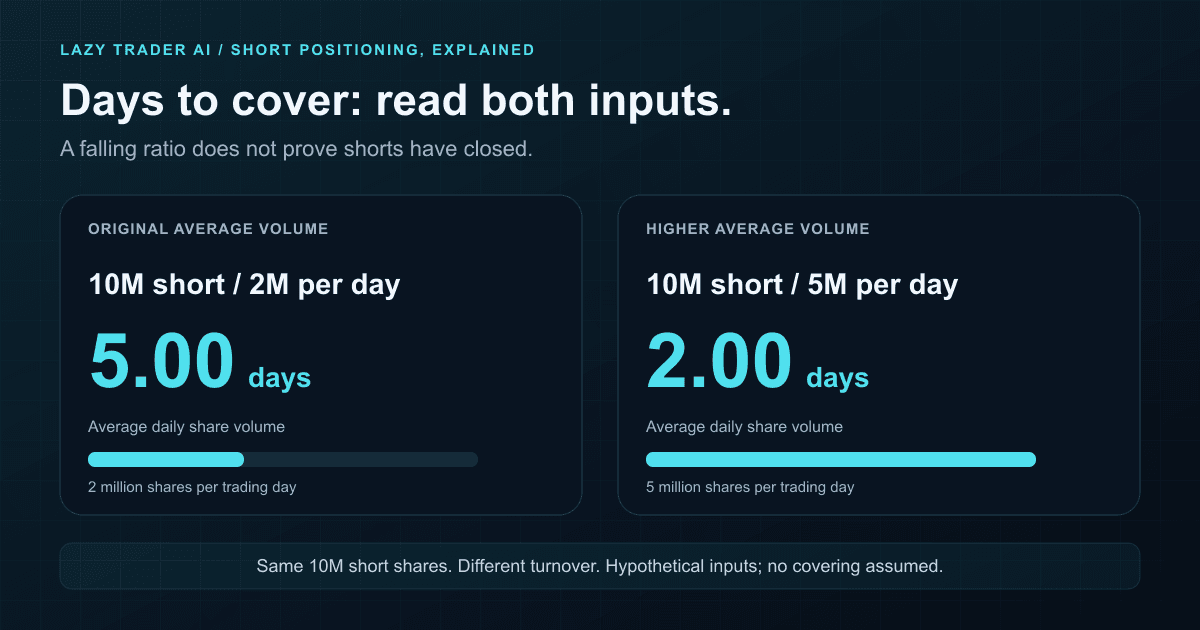
Days to Cover: Calculate the Short Interest Ratio
Use the free days-to-cover calculator, understand what a high short interest ratio means, and learn why a falling ratio does not prove shorts have covered.
Lazy Trader AI Research · Nov 4, 2026 · 8 min read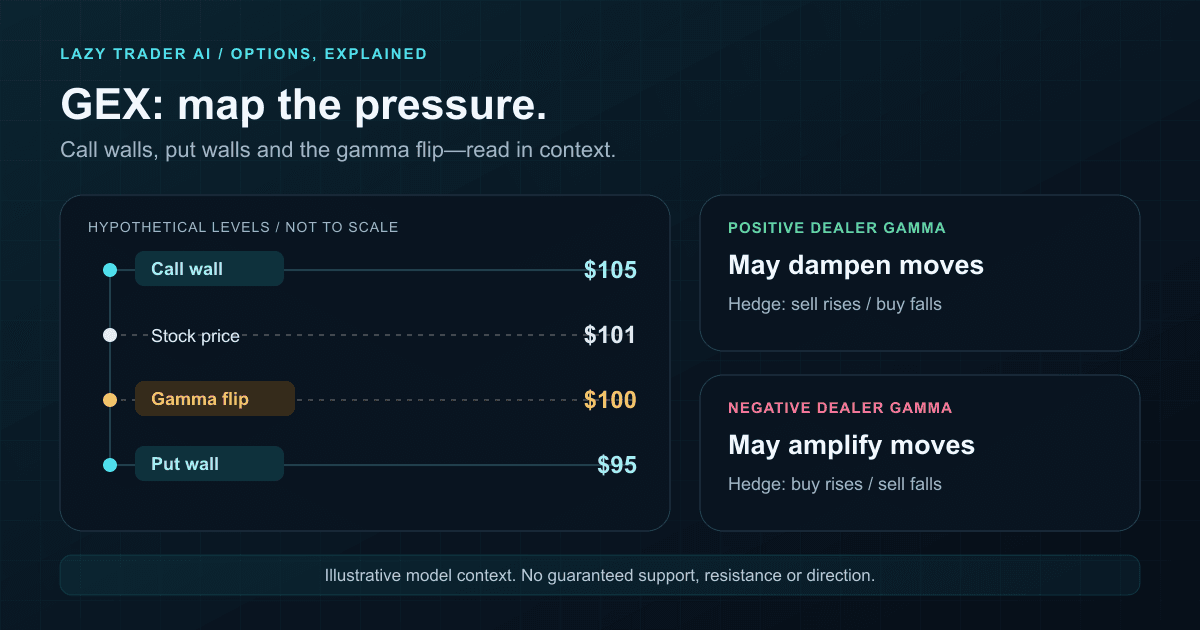
Gamma Exposure Explained: Call Walls, Put Walls and the Gamma Flip
What does GEX actually tell you? Understand dealer hedging, read call and put walls, and combine gamma levels with options flow and the earnings calendar.
Lazy Trader AI Research · Oct 29, 2026 · 8 min read