
IV Crush Explained: Why Your Call Can Lose After Earnings
Picking the stock’s direction is only part of an options trade. The price you pay for uncertainty matters too. Here is how to separate the stock move, the option premium and the event risk.
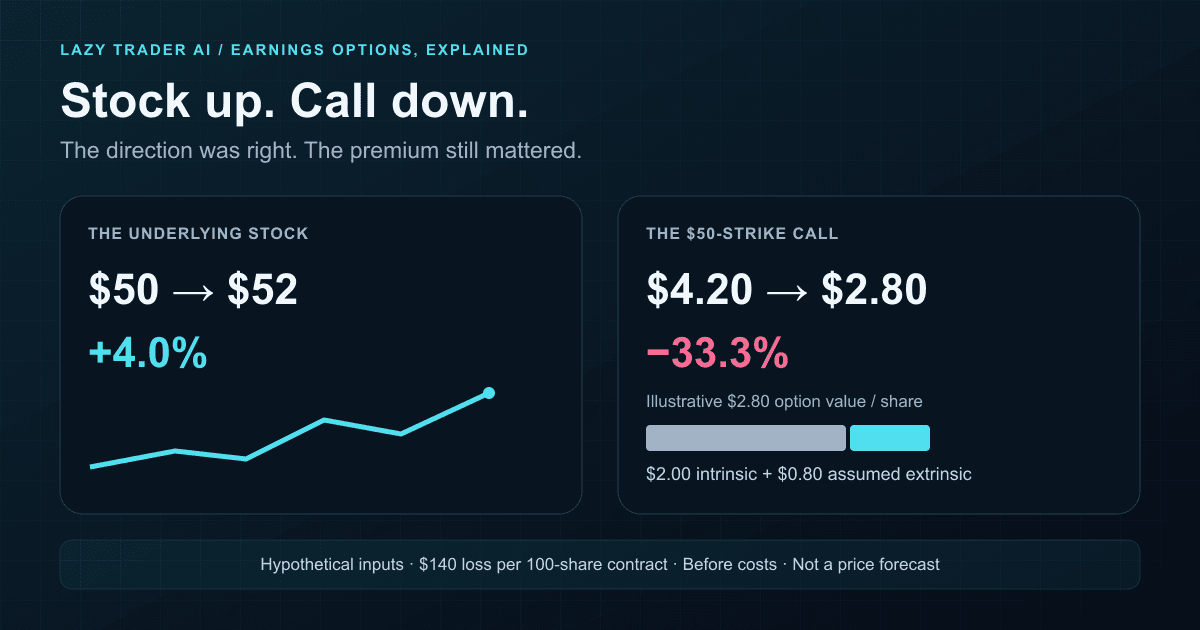
IV crush is a sharp fall in implied volatility, often after a scheduled event such as earnings. Lower IV can reduce an option's extrinsic value enough to outweigh a favorable stock move. A correct directional view does not guarantee a profitable call or put.
Implied volatility is inferred from option prices; it describes priced uncertainty, not whether the stock will rise or fall. Before results, buyers and sellers are pricing an unresolved event. Once the report arrives, that particular uncertainty may shrink. The Options Industry Council's IV-crush explanation describes why falling volatility can drag premiums lower.
The word can matters. Earnings do not guarantee an IV drop, a fixed percentage decline or an option loss. A report can introduce new uncertainty. The stock move can also be large enough to outweigh the change in premium. Examine the contract and its price rather than assuming every earnings trade has the same outcome.
Why a call can lose money when the stock goes up
Use a fictional stock at $50 and a $50-strike call bought for $4.20 per share. The option is initially at the money, so its premium is extrinsic value. Assume one ordinary 100-share contract costs $420 before fees.
After earnings, the stock rises to $52, a 4% gain. The call now has $2 of intrinsic value: $52 minus its $50 strike. Suppose the option has $0.80 of remaining extrinsic value. Its illustrative value is $2.80 per share, or $280 for that contract.
| Measure | Before earnings | After earnings assumption |
|---|---|---|
| Stock price | $50.00 | $52.00 (+4%) |
| Call intrinsic value / share | $0.00 | $2.00 |
| Extrinsic value / share | $4.20 | $0.80 (assumed) |
| Option premium / share | $4.20 paid | $2.80 illustrative value |
| One 100-share contract | $420 cost | $280 value; $140 loss (33.3%) |
The $3.40 decline in extrinsic value exceeds the $2 gain in intrinsic value. That explains the arithmetic. It does not prove the entire decline came from IV: elapsed time and other pricing inputs also matter. The $0.80 is our stated assumption, not a model output or a market quote.
The decomposition follows OIC's options-pricing definitions: premium consists of intrinsic value plus extrinsic, or time, value. This example uses a long call. Puts have the opposite intrinsic-value relationship to the stock, but falling IV can affect their premiums too.
Try the option-value scenario
Keep the same $50 strike and $4.20 purchase premium. Change the later stock price and the remaining extrinsic value. The tool shows how those assumptions combine; it does not estimate future IV or tell you what a contract will trade for.
One hypothetical $50-strike call bought for $4.20 per share ($420 for an assumed 100-share contract).
- Call intrinsic value / share
- $2.00
- Illustrative option value / share
- $2.80
This is arithmetic, not an IV pricing model. You supply the remaining extrinsic value; the tool does not predict it. No live quotes, fees, bid–ask spreads or exercise costs are included.
Try the larger-move preset: at a $57 stock price and the same assumed $0.80 extrinsic value, the call is worth $7.80. The hypothetical gain becomes $360 per contract. Direction, magnitude and premium paid belong in the same calculation.
The at-expiry break-even in this example is $54.20: strike plus premium paid, excluding costs. Before expiry, remaining extrinsic value can change the price at which you could close for a profit. Do not treat an expiry break-even as a universal next-morning threshold.
IV crush is different from time decay
Vega describes an option's sensitivity to an IV change. Theta describes sensitivity to time passing. Both can affect a position across an earnings release; they are not interchangeable explanations for every falling premium.
As a small, local approximation, a vega of $0.10 per share suggests about a $0.50 premium decline for a five-percentage-point IV fall, with other inputs held constant. OIC's vega guide explains that convention. Vega itself changes, so multiplying one reading across a large overnight move is not a full repricing model.
Also distinguish percentage points from a relative percentage: IV falling from 80% to 60% is a 20-point drop and a 25% relative decline. Neither number means the option must lose 20% or 25% of its premium.
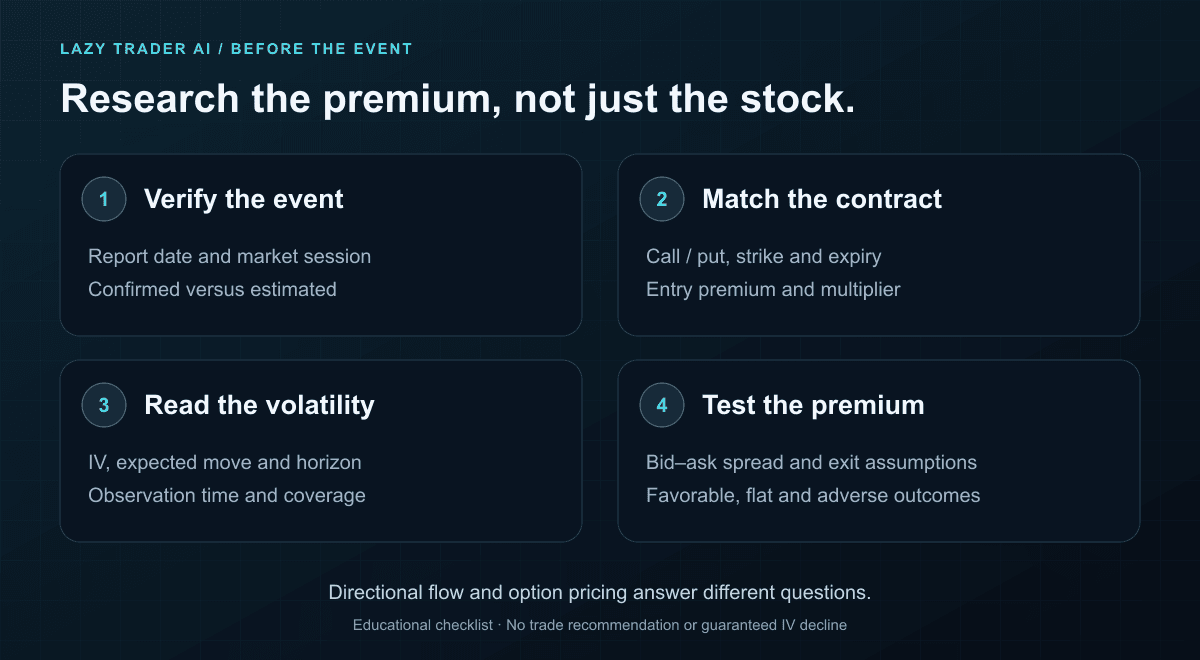
What to check before an earnings options trade
- Verify the event time. An after-close report and a before-open report expose different trading windows. Check whether the date is confirmed or estimated.
- Match the exact contract. Record call or put, strike, expiry and premium. A stock-wide IV reading does not describe every contract.
- Inspect the term structure. Compare IV across expirations around the event. A later expiry may contain other catalysts and does not make the position immune to IV changes.
- Read the expected move with its horizon. Check whether it covers an expiry, a week or the event specifically, and how the provider calculated it. It is not a directional target or a maximum possible move.
- Check the actual bid and ask. A midpoint, last trade or app valuation may not be an executable exit price. Include costs in a real position review.
- Write down more than one outcome. Test a favorable move, a flat stock and an adverse move with different remaining-premium assumptions. A single optimistic scenario hides the question you need to answer.
Cboe's earnings-options discussion highlights elevated event premiums and the risk that even a substantial stock move fails to cover an option position's cost. That is the reason to inspect the price of exposure, not just the expected company result.
Bullish options flow does not remove IV-crush risk
A large ask-side call print can be relevant execution evidence. It cannot tell you the buyer's whole portfolio, prove the position is unhedged, or make the contract's premium cheap. It may also be one leg of a larger trade. Keep the question “what activity occurred?” separate from “what am I paying for this exposure?”
Read our options-flow guide for execution context and IV rank versus IV percentile for historical-volatility context. A high rank is not a forecast of tomorrow's IV, and a low rank does not guarantee a bargain.
Bring the event, volatility and flow into one research view
In Lazy Trader AI, search for a ticker and review the earnings information, available volatility and expected-move fields, and options-flow context together. Read each module's observation time and coverage. If a field is missing, treat it as unavailable rather than a zero or a reassuring signal.
Instead of asking only whether a company will beat earnings, ask: “What event does this expiry cover, how much uncertainty is priced in, and what happens if the stock move is smaller than my premium needs?”
Create your research workspace to explore the platform. Free previews are available; some advanced data requires Premium and coverage varies by ticker.
Browse public ticker research first, or read our data methodology.
Common questions about IV crush
When does IV crush happen?
It can happen when a priced-in uncertainty resolves, often around earnings. The size and timing vary by stock, strike and expiry. There is no guaranteed overnight percentage drop.
Can puts lose from IV crush too?
Yes. Falling IV can reduce a put's extrinsic value as well as a call's. Whether the overall position gains or loses also depends on the stock move, time remaining and entry price.
Does selling options guarantee a profit from IV crush?
No. A sufficiently large adverse move can outweigh the benefit of lower IV. Short options also carry obligations, including potential assignment; some uncovered positions have unlimited loss potential.
Is the scenario tool an IV-crush calculator?
It demonstrates premium arithmetic using an extrinsic value you choose. It does not convert IV into a theoretical option price, fetch quotes, simulate a complete strategy or predict a profitable trade.
Sources and methodology
Reviewed November 9, 2026. All prices, contract values and returns in the examples are original hypothetical inputs. They are not live ticker data or a backtest. Contract examples assume a 100-share multiplier; adjusted contracts can differ. Values exclude transaction and exercise costs.
- Options Industry Council: Implied Volatility and the IV Crush.
- Options Industry Council: Options Pricing.
- Options Industry Council: Vega.
- Charles Schwab: What Is Implied Volatility?.
- Cboe: Trading Options Around Earnings Season.
For education and research only, not financial or investment advice. Options are not suitable for every investor, and buyers can lose their entire premium. See our risk disclosure.
Related research
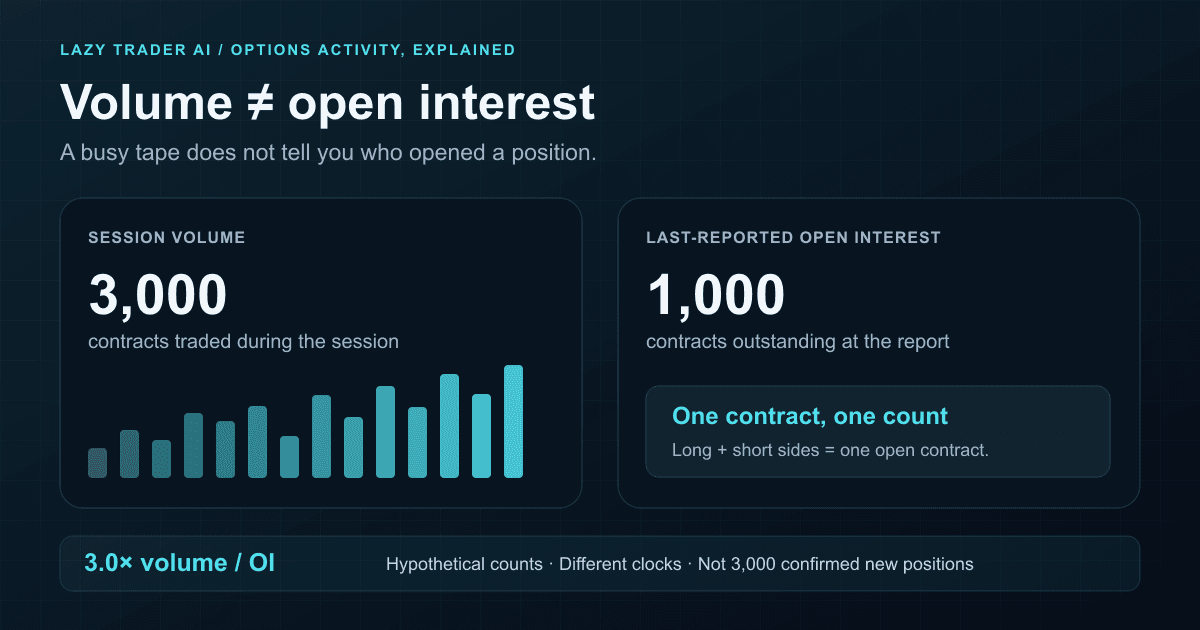
Options Volume vs. Open Interest: What a High Ratio Really Means
A contract trades three times its open interest. Is that fresh bullish buying? Learn what the numbers establish, what they leave out, and how to research the next step.
Lazy Trader AI Research · Nov 15, 2026 · 7 min read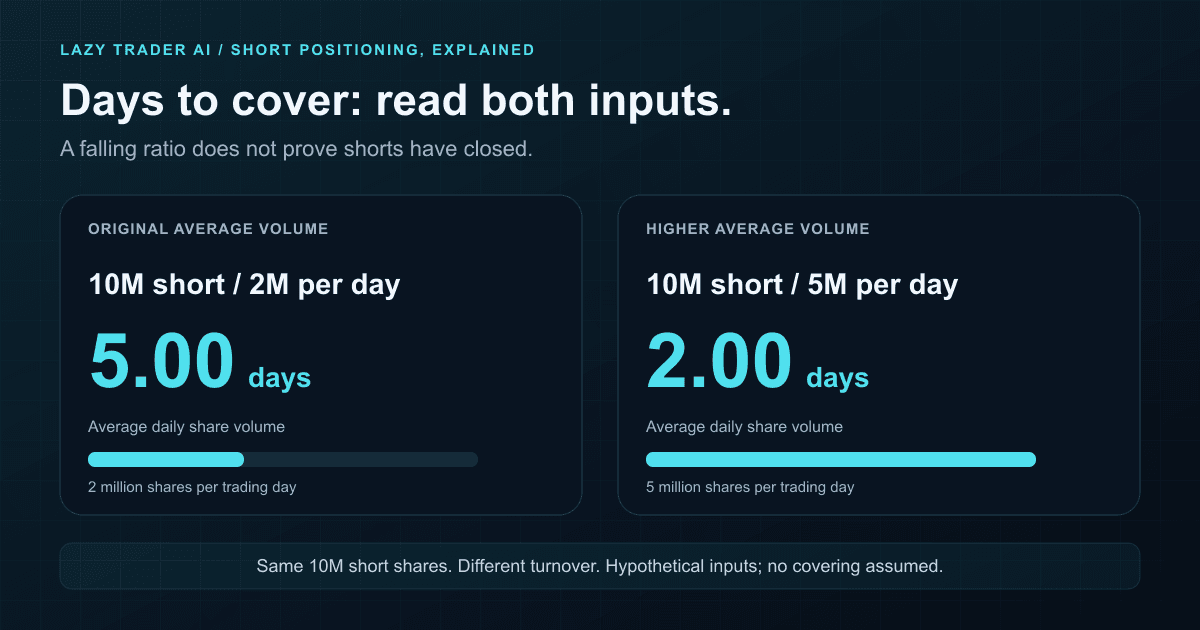
Days to Cover: Calculate the Short Interest Ratio
Use the free days-to-cover calculator, understand what a high short interest ratio means, and learn why a falling ratio does not prove shorts have covered.
Lazy Trader AI Research · Nov 4, 2026 · 8 min read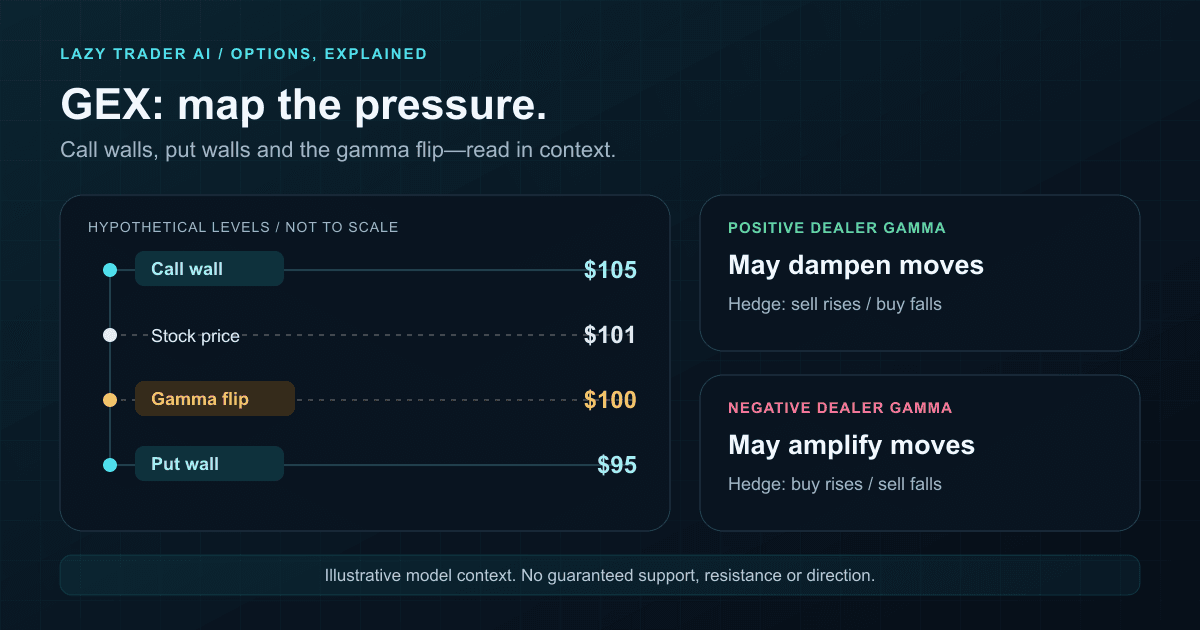
Gamma Exposure Explained: Call Walls, Put Walls and the Gamma Flip
What does GEX actually tell you? Understand dealer hedging, read call and put walls, and combine gamma levels with options flow and the earnings calendar.
Lazy Trader AI Research · Oct 29, 2026 · 8 min read