
How to Read Unusual Options Flow
Two trades can have the same premium and tell you very different things. Use the quoted spread, open interest, and related prints to interpret each one.
Unusual options flow is trading that stands out against a baseline, such as a large premium print or unusually high volume for a contract. The baseline matters. A $200,000 trade can be routine in a liquid ETF and unusual in a thinly traded stock.
Start with the underlying, call or put, strike, expiration, fill price, and size. From there, separate what you can observe from what you have to infer. A call filled near the ask can suggest aggressive call buying. Opening intent and the overall position are separate questions.
What you can read from a print
A print records a trade where a buyer and seller met. If you have the bid and ask from around the trade time, you can estimate which side crossed the spread. Prints near the midpoint, outside a reliable quote, or associated with a complex order can be harder to classify. Options Industry Council guide to the bid and ask.
Buying a call increases the buyer's positive delta on that leg. The trade could also close a short call, hedge another position, or sit inside a spread. A public trade print generally cannot establish who traded or why.
Four checks before drawing a conclusion
- Measure size in context. Multiply contracts by the per-share fill and the contract multiplier. Compare premium and volume against normal activity in that underlying.
- Check execution. Compare the fill to a contemporaneous bid and ask. Treat midpoint or ambiguous executions as unclassified.
- Compare volume and open interest. If 4,000 contracts trade on 500 reported open contracts, investigate the activity and check the next open-interest update. Both opening and closing trades contribute to volume. See our options volume versus open interest guide.
- Look for context. Find any related legs and repeated prints, check the expiration against catalysts, and consider whether the move in the underlying supports your interpretation.
Two worked examples
Ask-side call activity. In a hypothetical stock, 1,000 standard calls trade for $2.50 with a $2.40 bid and $2.50 ask. That is $250,000 in premium and an ask-side execution read. If 700 open contracts were reported before the session, the trade alone exceeded that count. It still takes more evidence to determine whether new exposure was opened.
Large put, unclear direction. Another 1,000 contracts trade for $2.50 with a $2.40 bid and $2.60 ask. That is the same $250,000 in put premium, with an unclear execution side. Calling it $250,000 of bearish buying would go beyond the tape.
What to leave out of your totals
Deduplicate reports of the same trade. If you are analyzing a sample, record its time window and print count. Call and put premium describe contract type. Bullish, bearish, and unclassified execution describe your interpretation of the fill. Keep those totals separate. See how to read sweeps and blocks when several prints appear together.
Review a real print
Open the Lazy Trader options flow preview and pick a contract to investigate. If your tape includes size and a contemporaneous quote, calculate the premium and compare the fill with the spread. Record what you observe and what remains unknown about opening intent or related legs.
Related research
Options Sweeps vs. Block Trades: How to Read Each Print
Compare a multi-venue sweep with a large block print, then see what execution prices can and cannot tell you about the trade.
Devon Park · Apr 5, 2026 · 4 min read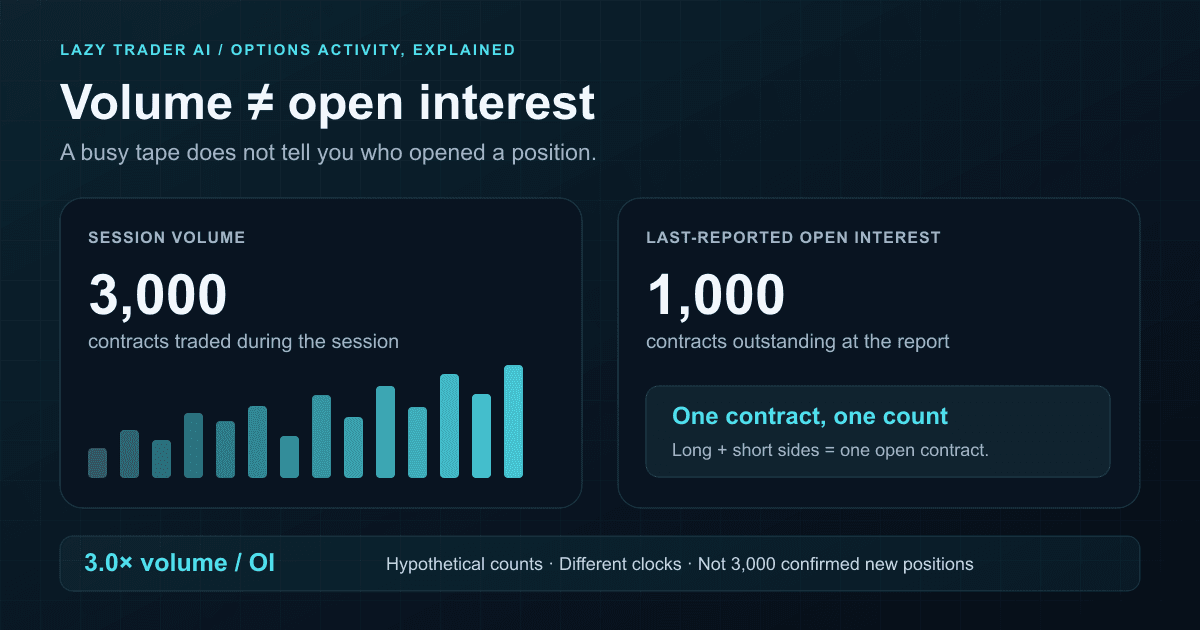
Options Volume vs. Open Interest: What a High Ratio Really Means
A contract trades three times its open interest. Is that fresh bullish buying? Learn what the numbers establish, what they leave out, and how to research the next step.
Lazy Trader AI Research · Nov 15, 2026 · 7 min read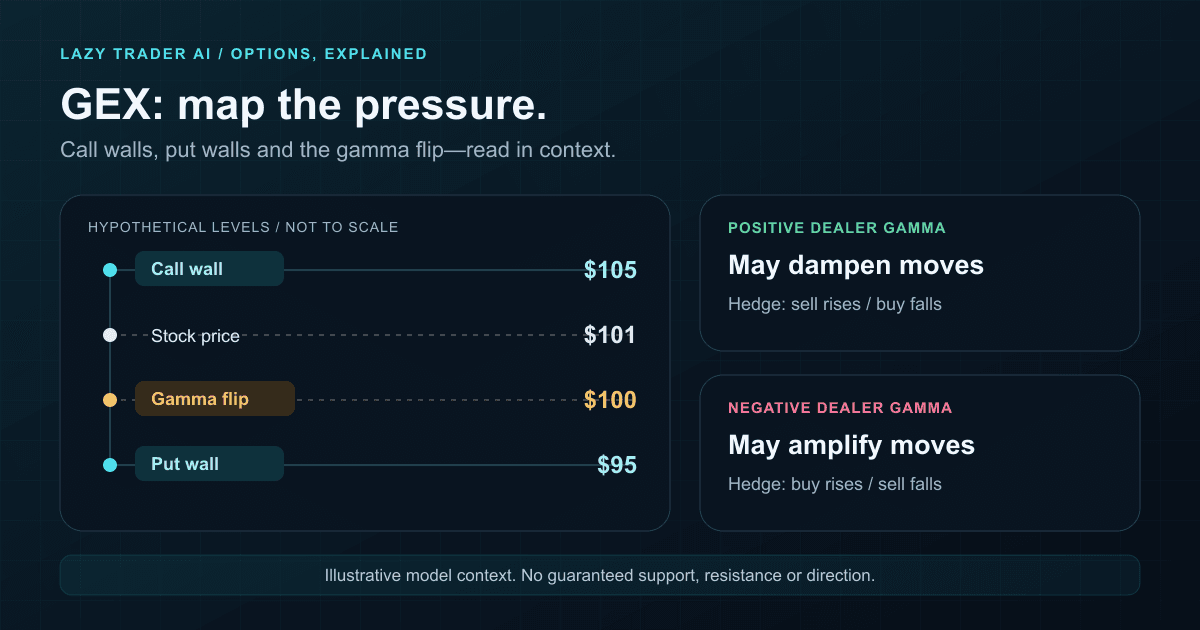
Gamma Exposure Explained: Call Walls, Put Walls and the Gamma Flip
What does GEX actually tell you? Understand dealer hedging, read call and put walls, and combine gamma levels with options flow and the earnings calendar.
Lazy Trader AI Research · Oct 29, 2026 · 8 min read