
What Is Delta in Options? Call, Put, and Position Examples
A +0.60 call implies about a $0.60 premium increase per share for a small $1 rise in the stock, with other pricing inputs held steady. Multiply by 100 for a standard equity option contract.
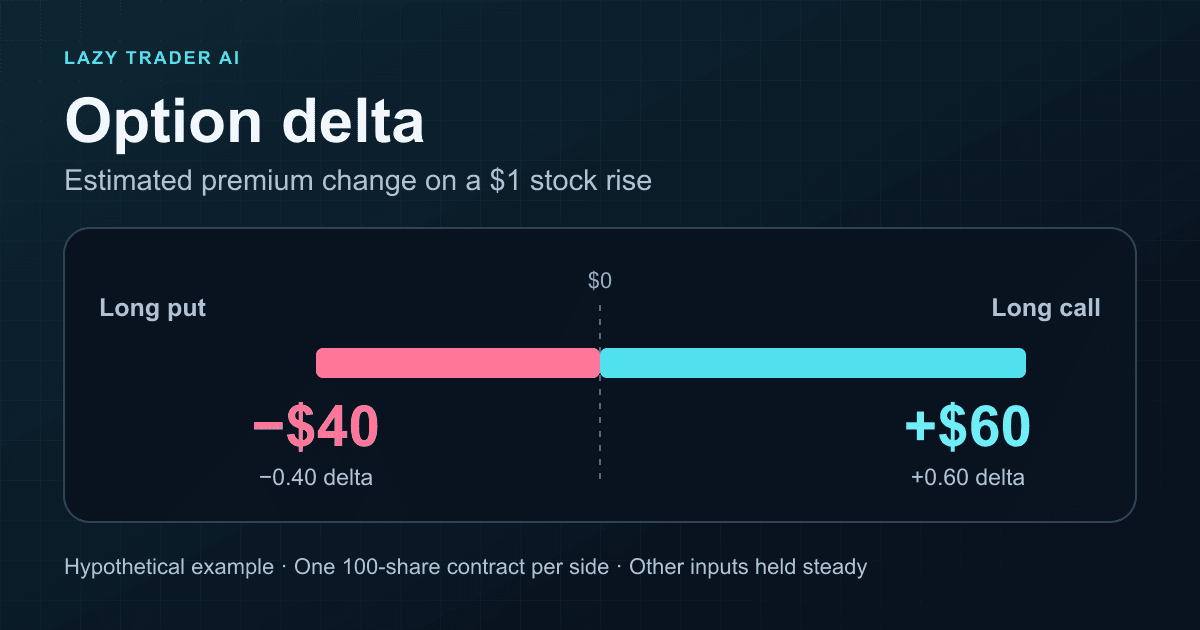
Estimated premium change per share ≈ delta × change in stock price. Multiply by the contract multiplier to get the estimated change per contract. For a short position, reverse the sign to get the impact on your position.
Option delta measures how sensitive an option's theoretical price is to a small move in the underlying. Calls have delta between 0 and +1, and puts between −1 and 0. The sign tells you how the premium is expected to respond to a stock move. The magnitude tells you the size of that initial response. Options Industry Council guide to delta.
Suppose a fictional $52 stock rises to $53. A $50 call has a premium of $3.30 and a delta of +0.60. Using the starting delta alone, its estimated premium rises to $3.90. A $50 put with a starting premium of $1.25 and a delta of −0.40 falls to an estimated $0.85. The moves are about +$60 and −$40 per standard contract before costs. OCC equity option contract specifications.
Why call and put delta have opposite signs
A stock rise makes the right to buy at a fixed strike more valuable and the right to sell at that strike less valuable, all else equal. The chain usually shows the sensitivity of the contract's premium. The sign of your position's exposure also depends on whether you bought or sold the option.
| Position | Chain delta | Share-equivalent exposure | Estimated impact |
|---|---|---|---|
| Long call | +0.60 | +60 shares | +$60 |
| Short call | +0.60 | −60 shares | −$60 |
| Long put | −0.40 | −40 shares | −$40 |
| Short put | −0.40 | +40 shares | +$40 |
With the same starting deltas, a small $1 fall reverses the estimated impacts. Some platforms display +0.60 as a 60-delta call. A put described as a 40-delta put often refers to its magnitude, so confirm the display convention. Use the signed delta for calculations.
How to calculate position delta across shares and options
For each options leg, multiply its chain delta by the contract multiplier and signed contract quantity. Use positive quantity for a long position and negative for a short position. Then add the exposures for all legs on the same underlying. Each long share of that stock contributes +1.
Imagine you own 100 shares and one −0.40 delta put with a 100-share multiplier. The combined delta is 100 + (−0.40 × 100) = +60 shares. A small $1 fall initially translates to about −$100 on the stock and +$40 on the put, or −$60 combined. Actual prices can move differently as the option reprices, and the total trade P/L also depends on the entry cost.
The same approach works for an options spread. One long +0.60 call and one short +0.30 call, both with a 100-share multiplier, give approximately +30 shares of net delta. When calculating exposures, group by underlying and confirm the multiplier on each leg. Corporate actions can change contract terms. OCC equity option contract specifications.
Delta vs. gamma and what changes the estimate
Delta measures how the premium responds to the stock. Gamma measures how delta itself responds to the stock. If the call starts at +0.60 delta and +0.04 gamma, a small $1 stock rise puts its new delta near +0.64, assuming gamma holds over that move. Use the latest delta for the next estimate. Options Industry Council guide to gamma.
Near-the-money options can change delta quickly as expiration approaches. Implied volatility and time remaining can also shift delta or change the premium independently. Around earnings, a drop in implied volatility can offset a move that would otherwise help the option. See the worked IV crush example and how gamma changes hedge exposure.
How to use delta when you see an options trade
- Match the series. Check underlying, expiration, strike, and call or put. Use the delta from around the trade time if available. Work through an example options chain.
- Compare size in the right units. Twenty 0.60-delta calls represent about 1,200 share-equivalents on the buyer's side at that estimate. Reported premium measures the money traded. Delta measures sensitivity to a move in the stock.
- Check the execution and other legs. The same call can be bought or sold, and a print can be one leg of a spread or a hedge. Describe exposure with the side and legs you can verify. See how to interpret an unusual-flow print.
Pick an alert in the public options-flow preview and match the series in your chain. Then open the Lazy Trader AI workspace to check the ticker's available flow, volatility, and earnings context. Coverage varies by ticker, and some data requires Premium.
Common questions about option delta
Does a 0.60 delta mean a 60% chance of profit?
Some traders use absolute delta as a rough, model-dependent proxy for the chance of expiring in the money. Profit also depends on the premium paid and costs. A long $50 call bought for $3.30 breaks even at $53.30 at expiration before costs. At a $52 close, it finishes $2 in the money and loses $1.30 per share on the trade. Cboe on interpreting delta as a probability proxy.
What is a good delta for an option?
Start with the exposure you are trying to understand. A higher absolute delta implies more immediate sensitivity to the stock. A lower absolute delta implies less at that moment. Ask how long the option has until expiration, what events come first, and whether the premium and spread fit the scenario you are evaluating.
Can my position be delta-neutral and still lose money?
Yes. A near-zero net delta offsets the initial sensitivity to a small stock move. As the stock moves, gamma can change that balance. Time decay, changes in implied volatility, and trading costs can also create gains or losses.
Sources and example assumptions
The stock, premiums, and Greeks are hypothetical. Dollar examples use a 100-share multiplier and exclude fees and taxes.
- Options Industry Council delta reference
- Options Industry Council gamma reference
- OCC standard equity option specifications
- Cboe on options probabilities and risk
For education and research only. Options involve risk. See our risk disclosure.
Related research
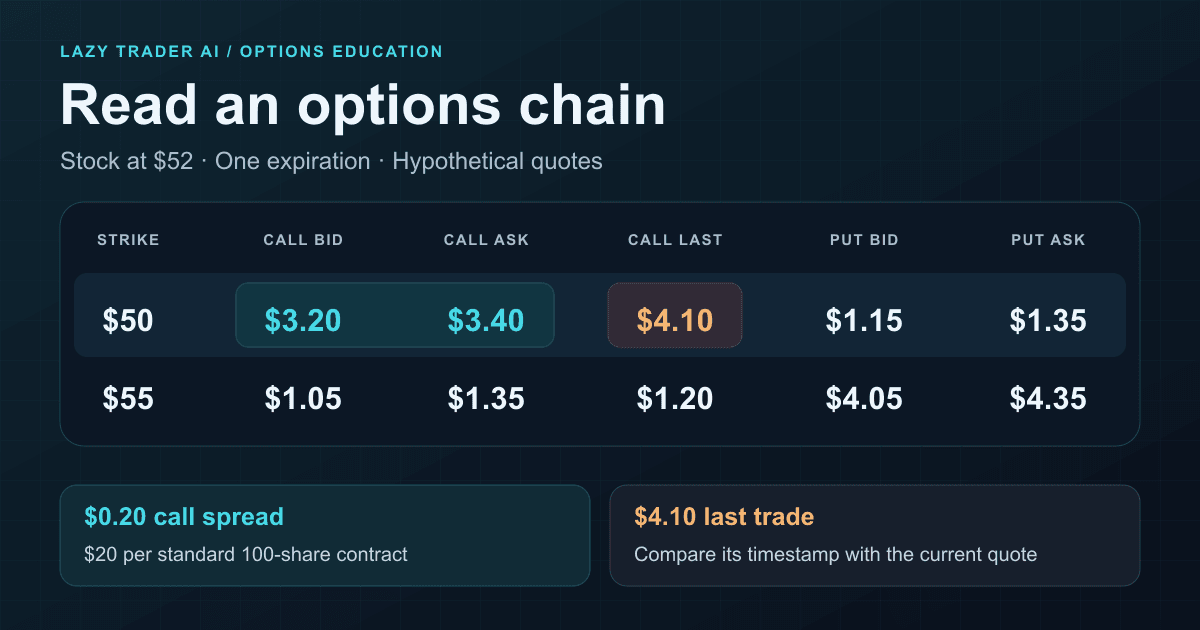
How to Read an Options Chain: A Worked Example for Beginners
Follow a sample call and put through the chain. Learn which price is current, what a quoted spread costs per contract, and how to match a flow alert to the right option.
Lazy Trader AI Research · Nov 22, 2026 · 6 min read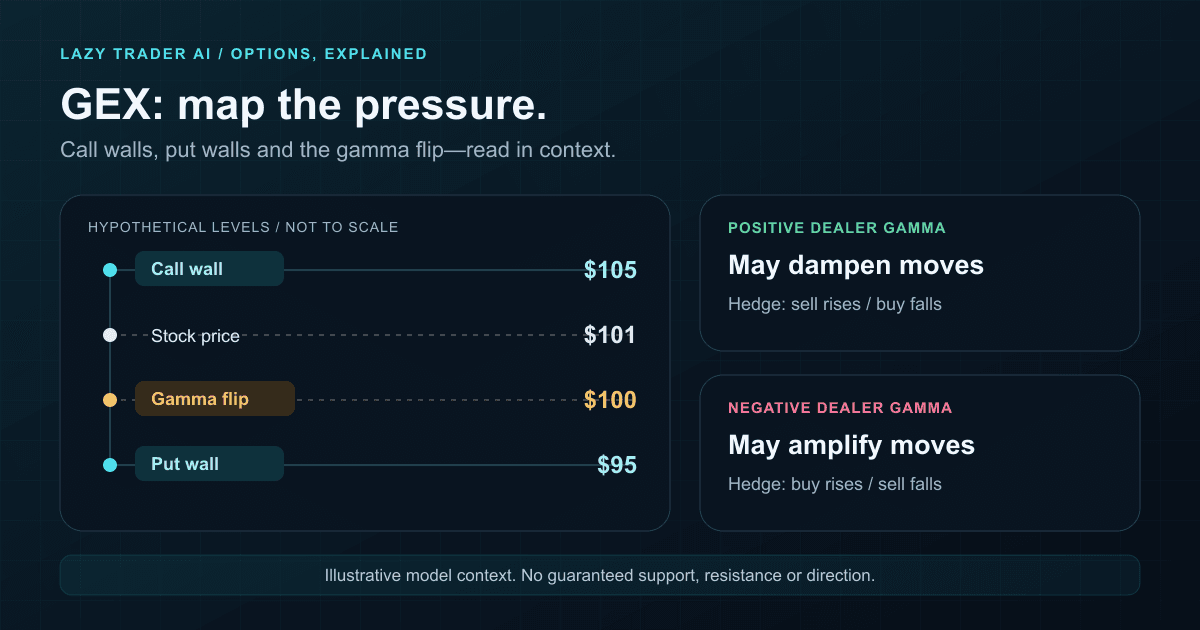
Gamma Exposure Explained: Call Walls, Put Walls and the Gamma Flip
What does GEX actually tell you? Understand dealer hedging, read call and put walls, and combine gamma levels with options flow and the earnings calendar.
Lazy Trader AI Research · Oct 29, 2026 · 8 min readHow to Read Unusual Options Flow
Learn how to inspect option premium, fill side, volume versus open interest, and related legs before interpreting an unusual options trade.
Mira Chen · Apr 22, 2026 · 6 min read